
Devanagari (Nagari)
Script details
Section titled “Script details”See all script details: code, region, status and more
| Code | Deva |
| Script type | abugida |
| Region | South Asian |
| Status | Current |
| Direction | LTR |
| Baseline | hanging |
| Case | no |
| White space | between words |
| Complex behaviors | diacritics, contextual forms, complex positioning, reordering, required ligatures |
| OpenType code | deva, dev2 |
| ISO 15924 Number | 315 (alphasyllabic) |
Script description
Section titled “Script description”Devanagari is a Northern Brahmic script related to many other South Asian scripts including Gujarati, Bengali, and Gurmukhi, and, more distantly, to a number of South-East Asian scripts including Thai, Balinese, and Baybayin.The script is used for over 120 spoken Indo-Aryan languages, including Hindi, Nepali, Marathi, Maithili, Awadhi, Newari and Bhojpuri. It is also used for writing Classical Sanskrit texts. Generally the orthography of the script reflects the pronunciation of the language.
The script is written from left to right. Letters hang from a headstroke, which is generally continuous throughout the length of the word, except when writing the letters jha, tha, dha, bha, a and ā, which all have a break in the headstroke. In handwriting, the headstroke is sometimes omitted.
Devanagari is an abugida; each letter represents a consonant with an inherent [ə] vowel, which can be modified using vowel diacritics. Vowel diacritics can be written above, below, to the left or to the right of the consonant. There are thirty-two consonant and ten vowel letters, plus ten vowel diacritics. The vowel signs represent long and short forms of five vowel sounds. Vowel sounds which are not preceded by a consonant are written with a vowel letter; otherwise they are indicated by a vowel diacritic, or, in the case of [ə], the lack thereof. There are also two letters for the long and short forms of the syllabic consonant [r̩], which are ordered with the vowel letters.
The Brahmic scripts are known for ordering the letters according to the principles of articulatory phonetics, that is, according to the place and manner in which the sound is produced. In Devanagari, the vowels are ordered first, with each short vowel followed by its long equivalent. The consonants are ordered by place, and within place, manner of articulation. Consonants are ordered in rows; velar, palatal, retroflex, dental, labial. Within each row, they follow the order unaspirated and aspirated voiceless, unaspirated and aspirated voiced, and nasal. Sonorants, fricatives and sibilants are ordered last.
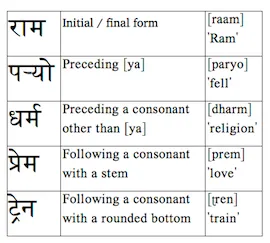
Some letters take variant forms depending on their context. Notably, the letter ra takes different forms when in initial/final position, when preceding the letter ya, when preceding a consonant other than ya, when following a consonant with a vertical stem, and when following a letter with a rounded bottom.
Most consonants have two forms; a ‘full’ form and a ‘half’ form, which often visually resembles the full form but is missing the vertical stem. The half forms can combine with the full forms of other letters to represent consonant clusters. Those letters which don’t have a half form make use of a halant symbol which silences the inherent vowel so that the two consonants can be pronounced in sequence. Some combinations join horizontally and some stack vertically. This is generally governed by the shape of the letter. A number of ligatures (commonly called conjuncts when referring to Indic scripts) are also used which do not bear visual similarity to the individual letters of which they are comprised.
Devanagari writing employs three non-alphabetic symbols for modifying the quality of a vowel. Anusvara is written with a dot above the vowel and either nasalizes the vowel or represents a nasal consonant articulated at the same place as the following consonant. A variant form of this symbol is called candrabindu and is written with a ‘moon dot’ above the letter to represent nasalization of the vowel exclusively. The symbol visarga follows anusvara; this symbol represents a voiceless breath following the vowel, and is written with two dots stacked vertically.
Languages that use this script
Section titled “Languages that use this script”| Language | Writing System Code | Writing System Status | SLDR/CLDR locale | Regional variants |
|---|---|---|---|---|
| Agariya | agi-Deva | in use | agi-Deva-IN (India) | |
| Ahirani | ahr-Deva | in use | ahr-Deva-IN (India) | |
| Andh | anr-Deva | in use | anr-Deva-IN (India) | |
| Angika | anp-Deva | in use | anp-Deva-IN (India) | |
| Asuri | asr-Deva | in use | asr-Deva-IN (India) | |
| See complete list | ||||
Unicode status
Section titled “Unicode status”In The Unicode Standard, Devanagari script implementation is discussed in Chapter 12 South and Central Asia-I — Official Scripts of India .
.
Other:
Resources
Section titled “Resources”Related articles
- Alternate digits in Devanagari
- Alternate forms of dya and hya
- Alternate forms of jha
- Alternate forms of kra, tra, and shra conjuncts
- Archaic form of kssa conjunct
- Archaic form of nna - Visual comparison between the standard and archaic form of U+0923 Devanagari Letter Nna
- Archaic vowel forms in Devanagari
- Complex Behaviors - An overview of various kinds of complex behaviors
- Devanagari Transliteration
- Marking Tone
- Nepali inscription written in the Devanagari script
- OpenType - Features and lookups
- Page Layout - Cultural expectations and patterns in page desiugn
- Paragraph Layout - Issues in paragraph layout
- Position of lower dot with ekar
- Position of lower dot with ukar
- Punctuation - Description and examples of punctuation
- Ra, reph and rakar in Devanagari
- Reordering and Data Storage Order
- Virama or Halant, which model do I choose?
- Visarga and glottal stop alternates
- Writing Conjuncts in the Devanagari Script
Grapheme and phoneme data
Section titled “Grapheme and phoneme data”Data indicating how characters are used to represent sounds is available for the following language as written with Devanagari script:
External links
- Devanagari (Wikipedia)
- Devanagari (Omniglot)
- ALA-LC Romanization Tables
- An Introduction to Indic Scripts (r12a.io)
- Brahmi Descended Scripts
- Devanagari Gap Analysis (W3C)
- Devanagari shaping in OpenType
- Developing OpenType Fonts for Devanagari Script (Microsoft)
- Hindi Letters and Sounds (I Speak Hindi)
- Indic script shaping in OpenType
- Ishida: List of terms to find letter combinations (r12a.io)
- Ishida: Notes on Scripts, Orthographies and Characters, Lists of Terms (r12a.io)
- Sanskrit (The Language Gulper)
- Saraiki in Devanagari Script (Wikipedia)
- Script comparison table (r12a.io)
- Unicode character pickers (r12a.io)
- UTN #10, An Introduction to Indic Scripts (Unicode)
- Vedic Extensions in OpenType
Bibliography
- Bright, William. “The Devanagari Script”. The World's Writing Systems , edited by Peter T. Daniels and William Bright , Oxford University Press , 1996 , pp. 384-390 .
- Campbell, George L. Concise Compendium of the World's Languages. Routledge , 2011 .
- Jain, Dhanesh and George Cardona. “Nagari (Devanagari) Script”. The Indo-Aryan Languages , Routledge , 2003 , pp. 75-80 .
- Kandhadai, Padmapriya and Richard Sproat. “Impact of spatial ordering of graphemes in alphasyllabic scripts on phonemic awareness in Indic languages”. Writing Systems Research , vol. 2 , no. 2 , 2010 , http://www.tandfonline.com/doi/abs/10.1093/wsr/wsq009.
- Meletis, Dimitrios and Christa Dürscheid. Writing Systems and Their Use. De Gruyter Mouton , 2022 , https://www.degruyter.com/document/doi/10.1515/9783110757835/html#contents.