
Ra, reph and rakar in Devanagari
The letter र forms distinctive conjuncts when it occurs in the same syllable as another consonant - i.e., when it is joined by a halant (virama). Note that the halant character ( ◌् ) must be present in the encoded data but will not be visible in the conjunct.
When a ra precedes another consonant in the same syllable - i.e., when the characters in the data are: र + ◌् + consonant - it takes the shape of a “reph”. The reph looks like a curl that sits above the “clothesline” that the letters hang from. The following image shows the reph attached to several different consonants.
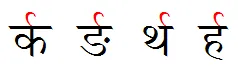
When the ra follows a consonant in the same syllable - when the characters in the data are: consonant + ◌् + र - it is written as a “rakar”. A rakar can have several different forms depending on the shape of the consonant it is attached to.
When a rakar is attached to a consonant with a vertical stem, such as क or थ, it is written as a short diagonal stroke off the vertical stem. The following image shows these consonants (gray) and the form of their rakar conjuncts.
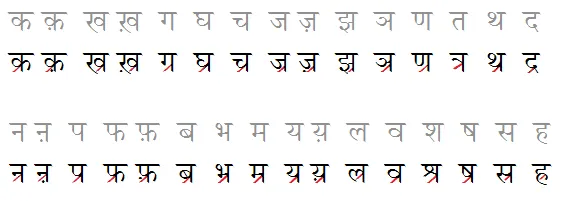
Note that for a handful of letters, the basic shape of the letter also gets modified:
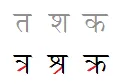
(The final form above is an alternate form of the kra conjunct.)
When rakar is attached to a consonant without a vertical stem, such as ङ or ठ, it is written as a shape similar to a circumflex (◌̭) below the consonant. The following image shows these consonants (gray) and the form of their rakar conjuncts.
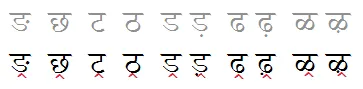
Note the exceptions to the rules:
- द : although it does not have a vertical stem, the shape of the letter requires the rakar to be written as a short diagonal stroke:

- ह : although it does not have a vertical stem, the diagonal stroke is attached to the lower curve:

Eyelash forms
Section titled “Eyelash forms”Although the letter rra ( ऱ) looks similar to the ra (र), it is written differently when it precedes another consonant in a syllable. The rra takes on the “eyelash” form as shown below.
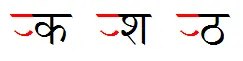
When rra follows another consonant in a syllable, the first consonant takes on the half-form.
The eyelash form can also be used for the letter ra itself (). This tends to occur before certain letters such as य or possibly ह . This is indicated by a zero-width joiner character () after the ra and halant - i.e., the characters are र + ◌् + + consonant. Note that there is no visible difference between the sequence ऱ + ◌् and र + ◌् + (the latter being much more common).
Languages which use both र and ऱ in their orthography may want to preserve the dot when half-ऱ is rendered as the eyelash form, as shown below. This is accomplished by adding the zero-width joiner after the halant.

Exceptions
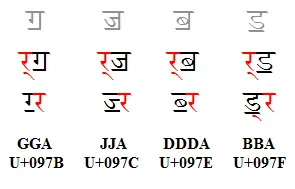
Section titled “Exceptions”As with other Devanagari consonants, it is possible to change the behavior of the ra by the use of the zero-width joiner () or zero-width non-joiner (). Inserting a ZWNJ after the halant results in the explicit halant and/or half-form instead of the reph and rakar conjuncts. This is used, for example, in consonant clusters containing modern additions to the Devanagari script, such as the Sindhi letters shown below.
Reph + rakar
Section titled “Reph + rakar”It is rare but possible to have a single syllable containing both the reph and the rakar, as shown below.

This article formerly appeared on ScriptSource.