
Tai Viet
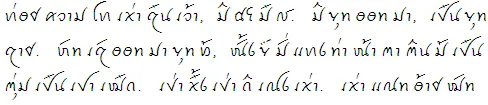
"Mr. Countless Warts", recorded 1969-70 by B.Q., transcribed by Jay and Dorothy Fippinger.
Image copyright © 2011 SIL Global with license CC BY-SA 3.0. Source: SIL.
Script details
Section titled “Script details”See all script details: code, region, status and more
| Code | Tavt |
| Script type | abugida |
| Region | Mainland Southeast Asian |
| Status | Current |
| Direction | LTR |
| Baseline | bottom |
| Case | no |
| White space | discretionary |
| Complex behaviors | diacritics, contextual forms, complex positioning, reordering, split graphs, required ligatures |
| OpenType code | tavt |
| ISO 15924 Number | 359 (alphasyllabic) |
Script description
Section titled “Script description”The Tai Viet script is used for writing the Tai Dam, Tai Dón, Tai Daeng, Thai Song and Tày Tac languages spoken in Vietnam, Laos, China and Thailand.
Read the full description…
Speakers of these languages are also found in the United States, Australia and France. There is significant variation in the orthographic conventions of the Tai languages, as well as in their phonologies, which in turn impacts the orthography. However, a unified, standardized version of the script, with an agreed upon core set of characters, was developed at a UNESCO-sponsored workshop in 2006, and subsequently accepted for encoding in The Unicode Standard.
The script is an abugida. Consonants do not contain an inherent vowel; vowels must be written explicitly. Vowel marks may appear above, below, before or after a syllable’s initial consonant. A written syllable therefore consists minimally of a consonant and a vowel. Optionally it may also contain a final consonant. There are two series of consonants, indicating high and low tone class. The Tai Viet script employs Latin punctuation as well as three non-alphabetic signs to indicate word repetition or a section break. It also uses two ligatures which may serve to disambiguate between homophonous words.
Traditionally, tone was only partially marked in the orthography. As in other Tai languages, tones were divided into two sets of three, and the appropriate selection of consonants from the high or low series indicated which set of tones the syllable belonged to. The reader had to determine the exact tone from context. However, around the 1970s, two different tone marking systems developed simultaneously in Vietnam and the United States; the concurrent use of both these systems is seen to be disadvantageous but, for the time being, unavoidable. There is no standard order for sorting characters. Some users have modified the order employed by the Lao script, others, the Vietnamese.
Little is known about the origin of the Tai Viet script. It appears to have been derived from the Thai script around the 16th century, which is in turn of Khmer, and ultimately Brahmic, origin.
Please note that, although the Tai Viet script does exhibit reordering behaviour, that reordering is not typically reflected in software implementations. See Syllable Structure and Reordering in Tai Viet or Reordering and Data Storage Order for more details.
Languages that use this script
Section titled “Languages that use this script”| Language | Writing System Code | Writing System Status | SLDR/CLDR locale | Regional variants |
|---|---|---|---|---|
| Tai Daeng | tyr-Tavt | in use | tyr-Tavt-VN (Viet Nam) | |
| Tai Dam | blt-Tavt | in use | blt (CLDR)  | blt-Tavt-VN (Viet Nam) |
| Tai Dón | twh-Tavt | in use | twh-Tavt-VN (Viet Nam) | |
| Thai Song | soa-Tavt | in use | soa-Tavt-TH (Thailand) | |
| Tày Tac | tyt-Tavt | in use | tyt-Tavt-VN (Viet Nam) |
Unicode status
Section titled “Unicode status”In The Unicode Standard, Tai Viet script implementation is discussed in Chapter 16: Southeast Asia-I — Thailand, Laos, Myanmar, Cambodia, Vietnam.
Resources
Section titled “Resources”Related articles
- Geographic Use of the Tai Viet Script
- Marking Tone
- Non-alphabetic Symbols in the Tai Viet Script
- Numerals in the Tai Viet Script
- Printed Tai Viet Text
- Punctuation in the Tai Viet Script
- Reordering and Data Storage Order
- Sociolinguistic Background of the Tai Viet Script
- Sorting Order of Tai Viet Characters
- Syllable Structure and Reordering in Tai Viet
- Tai Don Written in the Tai Viet Script
- Tai Viet by Phoneme - Consonants
- Tai Viet by Phoneme - Notes
- Tai Viet by Phoneme - Vowels and Tones
- Tai Viet Consonants
- Tai Viet Consonants - Final Forms
- Tai Viet Ideograms
- Tai Viet Storage Order in Unicode
- Tai Viet Vowels
- Tone Marking in Tai Viet
- Word Spacing in Tai Viet
- Writing Tai Dón in the Tai Viet Script
- Writing the Tai Dam language
Grapheme and phoneme data
Section titled “Grapheme and phoneme data”Data indicating how characters are used to represent sounds is available for the following language as written with Tai Viet script:
External links
- Tai Viet script (Wikipedia)
- Ishida: List of terms to find letter combinations (r12a.io)
- Ishida: Notes on Scripts, Orthographies and Characters, Lists of Terms (r12a.io)
- Script comparison table (r12a.io)
- Unicode character pickers (r12a.io)
Bibliography
- Don, Baccam, et al. Tai Dam-English English-Tai Dam Vocabulary Book. The Anundsen Publishing Company , 1989 .