
Lao
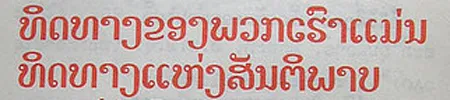
Book from Progress Printing in Moscow, 1979.
Image copyright © 2007 aysomphone with license CC BY-NC-SA 2.0. Source: Flickr.
Script details
Section titled “Script details”See all script details: code, region, status and more
| Code | Laoo |
| Script type | abugida |
| Region | Mainland Southeast Asian |
| Status | Current |
| Direction | LTR |
| Baseline | bottom |
| Case | no |
| White space | between phrases |
| Complex behaviors | diacritics, contextual forms, complex positioning, reordering, split graphs, required ligatures |
| OpenType code | lao |
| ISO 15924 Number | 356 (alphasyllabic) |
Script description
Section titled “Script description”The Lao script is used for writing the Lao language, and is also the official script of a number of minority languages in Laos.The Lao language is closely related to Thai; there is a considerable Lao-speaking population in Thailand who write their language with the Thai script. However, the Lao script underwent a number of reforms which caused significant divergence from the Thai script. When the communist Pathet Lao overthrew the Lao government in 1975, they implemented a final spelling reform which simplified and standardized the script.
There are 27 consonant letters in the Lao script. Many consonant letters are pronounced differently at the beginning and at the end of a syllable. However, not all consonant sounds or letters can occur at the end of a syllable.
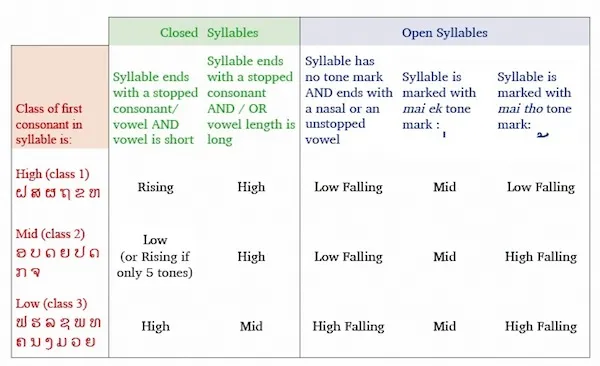
Linguists do not agree as to whether there are five or six tones in the Lao language; it may vary by dialect. The system for representing tone (illustrated below) is fairly complex. Consonant letters are divided into three tone classes. There are four tone marks, two of which are in common use. The class of consonant, the type of syllable (open or closed), vowel length, and the tone marker all combine to represent the tone of a syllable. Closed syllables do not carry a tone marker, but open syllables may. Tone can also be changed by ligating a consonant to a special (silent) letter.
Consonants carry an inherent [a] vowel, which can be modified by means of vowel signs written above, below, alongside or ‘around’ (in more than one position) the consonant. Long vowels are represented by seven vowel letters. Some short vowels are represented by adding a ‘short’ marker to the long vowel symbol, and others with a different symbol, often related in form to the long vowel symbol. Vowels are not written at the start of a syllable, although they can be the first sound in a syllable. In these cases, the symbol for a glottal stop is used as a base onto which the vowel letter can join.
Lao consonant letters are given names consisting of the consonant’s sound (in initial position), followed by the sound ‘aw’, and a second arbitrary word, normally the name of an animal or common object beginning with the sound in question. These names help to associate between letters representing the same sound. For example, there are two letters representing [s], one called ‘saw seua’ (seua meaning tiger) and the other called ‘saw sang’ (sang meaning elephant).
Lao has its own set of digits from 0-9. Some Latin punctuation is used in modern writing, in particular ! ? ( ) … Quotation marks may be in either "" or «» style. Spaces are used at the end of clauses or sentences, but not to break words. There are also Lao symbols equivalent to the English abbreviation ‘etc.’, to indicate repetition of a letter or word, and to indicate omission of a word.
Please note that, although orthographically the Lao script does exhibit reordering behaviour, that reordering is not typically reflected in software implementations. See Reordering and Data Storage Order for more details of this.
Languages that use this script
Section titled “Languages that use this script”| Language | Writing System Code | Writing System Status | SLDR/CLDR locale | Regional variants |
|---|---|---|---|---|
| Alak | alk-Laoo | unwritten | alk-Laoo-LA (Laos) | |
| Brao | brb-Laoo | in use | brb-Laoo-LA (Laos) | |
| Bru, Eastern | bru-Laoo | in use | bru-Laoo-LA (Laos) | |
| Bru, Western | brv-Laoo | in use | brv-Laoo-LA (Laos) | |
| Hmong Daw | mww-Laoo | in use | mww-Laoo-LA (Laos) | |
| See complete list | ||||
Unicode status
Section titled “Unicode status”In The Unicode Standard, Lao script implementation is discussed in Chapter 16: Southeast Asia-I — Thailand, Laos, Myanmar, Cambodia, Vietnam .
.
Other:
Resources
Section titled “Resources”Related articles
- Marking Tone
- Paragraph Layout - Issues in paragraph layout
- Reordering and Data Storage Order
- Sequence Checking in Thai and Lao - Article containing details of problematic or 'illegal' character sequences that have been encountered in languages using the Thai and Lao scripts, so that system and application developers may take them into account as they design.
External links
- Lao script (Wikipedia)
- Lao Alphabet (Omniglot)
- ALA-LC Romanization Tables
- Brahmi Descended Scripts
- Developing OpenType Fonts for Lao Script (Microsoft)
- Ishida: List of terms to find letter combinations (r12a.io)
- Ishida: Notes on Scripts, Orthographies and Characters, Lists of Terms (r12a.io)
- Lao Book From Progress Publishers (Flickr)
- Lao character picker (r12a.io)
- Lao Gap Analysis (W3C)
- Script comparison table (r12a.io)
- Scripts of South East Asia
- Thai and Lao shaping in OpenType
- Unicode character pickers (r12a.io)
Bibliography
- Campbell, George L. Concise Compendium of the World's Languages. Routledge , 2011 .
- Diller, Anthony. “Thai and Lao Writing”. The World's Writing Systems , edited by Peter T. Daniels and William Bright , Oxford University Press , 1996 , pp. 457-466 .
- Miller, Michelle. “A Description of Kmhmu’ Lao Script-Based Orthography”. Mon-Khmer Studies , edited by Paul Sidwell and Brian Migliazza , vol. 42 , 2013-05-14 , pp. 12-25 , http://mksjournal.org/mks42miller.pdf. Accessed 2026-10-07.