
Types of font families
Three types of font families
Section titled “Three types of font families”There are three types of font families. In general, standard applications should be able to support the first two types: RIBBI and Axis-based fonts. Variable fonts may need more attention to developing a UI to handle the potential weights.
RIBBI fonts
Section titled “RIBBI fonts”Users are most familiar with fonts that have up to four different standard faces: Regular, Italic, Bold, and Bold-Italic.
Axis-based fonts
Section titled “Axis-based fonts”Axis-based fonts generally go beyond the standard Regular, Italic, Bold, and Bold Italic type faces. They can provide other weights such as Thin, ExtraLight, Light, Medium, SemiBold, ExtraBold, Black, etc. They can also provide other styles as well, such as different widths.
Some applications will display these other weights as separate font families (except bold). Ideally, an application should see, for example, Gentium as one font with ten faces rather than as separate fonts.
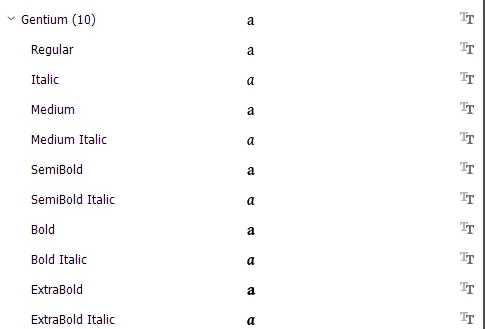
If a user selects the Regular weight of Gentium, an application could then use the Bold weight for contrast (such as in headings). If the user selects Medium, then the heavier weight (such as for headings) should be ExtraBold. Applications should provide two different selections for fonts to handle these situation; one selection for the body text (Regular or Medium), and one selection for the heaver weight (Bold or ExtraBold).
If an application uses a second weight (such as bold) then there needs to be two selections for fonts.
PTXprint handles this appropriately.
Variable fonts
Section titled “Variable fonts”Variable fonts have all the potential styles (axes) in one single font file. They are primarily used in web-based applications, and in that environment they can be more flexible than static fonts. Variable fonts allow for choosing any style such as
- weight (this is the most common axis)
- width
- slant
- optical size
Sliders or input fields are generally used to get the exact style required. Not all variable fonts support all the above axes, and some variable fonts support other axes as well.
Variable font families with italics are built as two variable fonts; one for upright styles, one for italic styles. The slant axis is not used to select the italic styles, a different axis is used (the italic axis). Unlike the other axes, the italic axis only has two values, upright or italic (not a range like the other axes).
Standard CSS properties like font-weight, font-style, or font-variation-settings can be used to fine-tune the preferred values.
Introducing variable fonts gives more details on Variable fonts.