What is a Warsh Orthography?
While developing a font intended for use in West Africa it was important to support the Warsh (Warš) orthography (or reading tradition) for the Arabic script. It was somewhat of a challenge to figure out what exactly that would mean. There is not much written on Warsh. Is it character selection, alternate rendering or perhaps style of characters? It seems that all of these are involved in a Warsh orthography.
Different or Same Characters?
Section titled “Different or Same Characters?”In the chart below we see how Warsh behavior contrasts with two other orthographic traditions - Hafs and Al-Duri. Hafs is the most common orthographic tradition for Modern Standard Arabic. Al-Duri is used in Sudan, Central Africa and some regions of Nigeria.
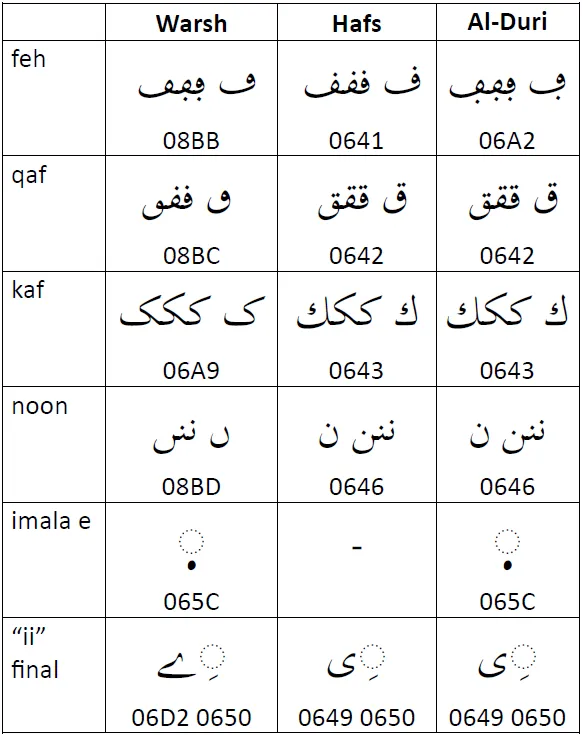
For the Hafs and Al-Duri orthographies it is a simple matter of choosing a different character. For example, the Hafs “feh” requires a nukta dot above and the Al-Duri “feh” requires a nukta dot below, but the four forms are consistent. The issue becomes more complex with Warsh. For some characters (kaf, imala e and “ii” final) it is a simple matter of using another codepoint. In the Warsh orthography the isolate and final “feh”, “qaf”, and “noon” must be dotless. These are now supported in Unicode at ࢻ , ࢼ , and ࢽ .
It is interesting to note that the imala e ( ◌ٜ ) is sometimes referred to as a “warsh dot”. The imala e should be large enough that it is not confused with a single nukat below other characters.
Positioning
Section titled “Positioning”Another aspect of Warsh is that the hamza on أ and إ actually touch the alef. To support this orthography, the characters in the range of U+0870..U+0882 were added to Unicode. This range supports a variety of characters such as fatha, kasra, and hamza touching above, below, or beside an alef.
Shadda plus kasra positioning
Section titled “Shadda plus kasra positioning”◌ِ normally appears below the consonant. However, when there is a ◌ّ plus a kasra, the kasra normally moves above the consonant (and below the shadda).
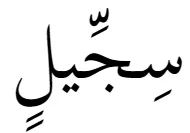
There are a number of languages which do not use this behavior, the kasra remains below the consonant even in the context of a shadda. The Warsh orthography follows this alternate behavior.
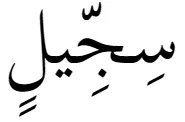
This kind of behavior should be programmed into the font.
Medial feh and qaf
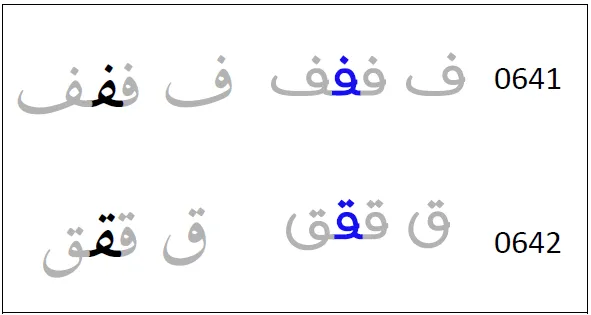
Section titled “Medial feh and qaf”In West Africa, where Warsh orthographies are common, the medial form of feh and qaf are written with the stroke of the pen lifted from the page and beginning above the baseline. The first column below is a more standard Arabic font, and the second column is the Warsh-style.
Are there other aspects of a Warsh orthography?
Section titled “Are there other aspects of a Warsh orthography?”I’m sure there are other aspects of what it means to support a Warsh orthography in a font. I would be interested in hearing what they are.